
Tourism projects are constantly changing. A resort may need additional guest rooms before the peak season, a scenic area may require accommodation in a remote location, and a holiday destination may want to develop new cabins without committing to a long and complicated construction process.
This is where modular tourism accommodation can provide a practical alternative to conventional construction.
From resort cabins and holiday homes to scenic-area accommodation and modular hotels, prefabricated and container-based buildings can be designed, manufactured, transported and installed according to the requirements of different tourism projects.
For developers, hotel operators, investors and project contractors, modular construction can offer a combination of flexibility, construction efficiency, scalability and design customization.
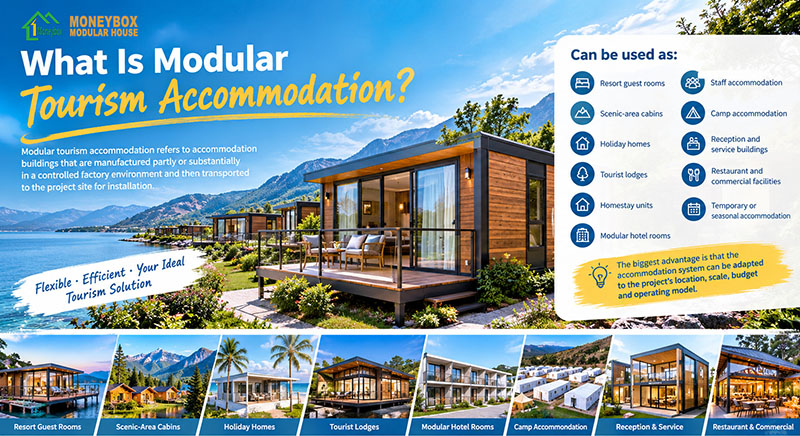
Modular tourism accommodation refers to accommodation buildings that are manufactured partly or substantially in a controlled factory environment and then transported to the project site for installation.
Unlike traditional buildings that are constructed almost entirely on-site, modular accommodation can be produced as individual units, structural components or complete modules.
Depending on the project requirements, these buildings can be used as:
The biggest advantage is that the accommodation system can be adapted to the project's location, scale, budget and operating model.
Why Are Modular Buildings Suitable for Tourism Projects?
Tourism development often involves locations where conventional construction is not always convenient.
A scenic attraction may be located in a mountainous area. A beach resort may need to expand quickly before the holiday season. A remote tourism destination may have limited construction infrastructure and skilled labor.
Modular buildings can help address these challenges.
1. Faster Project Deployment
A significant part of the manufacturing process can be completed in a factory while site preparation and foundation work are carried out simultaneously.
This parallel approach can reduce the amount of construction work that needs to be completed directly at the destination.
2. Flexible Project Expansion
Tourism projects rarely remain exactly the same throughout their entire operating life.
With a modular building system, additional accommodation can be planned as part of the overall development strategy.
Instead of designing the entire resort as one fixed construction project, developers can create accommodation in stages.
This makes modular solutions particularly suitable for:
New tourism developments → Initial accommodation → Seasonal expansion → Long-term capacity growth
3. Suitable for Remote Locations
Many tourism projects are developed precisely because of their natural surroundings.
Mountains, forests, islands, lakesides and other scenic destinations can create attractive tourism opportunities, but they can also make conventional construction more difficult.
Transportation and on-site construction conditions should therefore be considered at the design stage.
Modular and container-based accommodation can be engineered with transportation and installation requirements in mind, making them suitable for projects where construction logistics are an important consideration.
Modular Accommodation for Resorts
Resorts are one of the most obvious applications for modular tourism accommodation.
A resort may require independent guest units rather than a traditional multi-story hotel.
Modular accommodation can be arranged as:
The units can also be arranged according to the landscape.
This allows the building system to become part of the overall tourism experience rather than simply functioning as a conventional accommodation block.
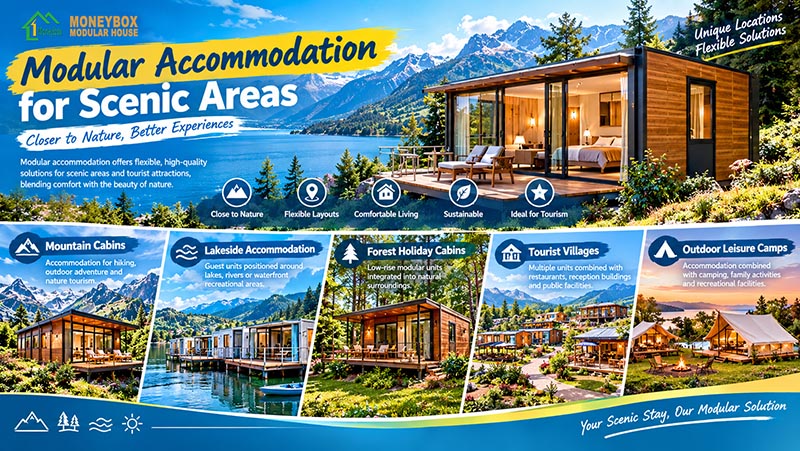
Modular Accommodation for Scenic Areas
Scenic areas and tourist attractions often have unique site conditions.
Accommodation may need to be located close to forests, mountains, lakes, cultural attractions or outdoor activity areas.
In these situations, modular accommodation can provide greater flexibility than conventional construction.
For example, a tourism operator could develop:
Mountain cabins
Accommodation for hiking, outdoor adventure and nature tourism.
Lakeside accommodation
Guest units positioned around lakes, rivers or waterfront recreational areas.
Forest holiday cabins
Low-rise modular units integrated into natural surroundings.
Tourist villages
Multiple modular accommodation units combined with restaurants, reception buildings and public facilities.
Outdoor leisure camps
Accommodation combined with camping, family activities and recreational facilities.
Modular Accommodation for Homestays and Holiday Projects
The growth of homestays and independent holiday properties has created another opportunity for modular buildings.
A modular solution can allow investors to start with a smaller project and expand later.
For example:
Phase 1: 5–10 guest units
Phase 2: Additional accommodation units
Phase 3: Reception, restaurant and commercial facilities
Phase 4: Complete holiday village or resort
This staged approach can help project owners match construction investment with actual market demand.
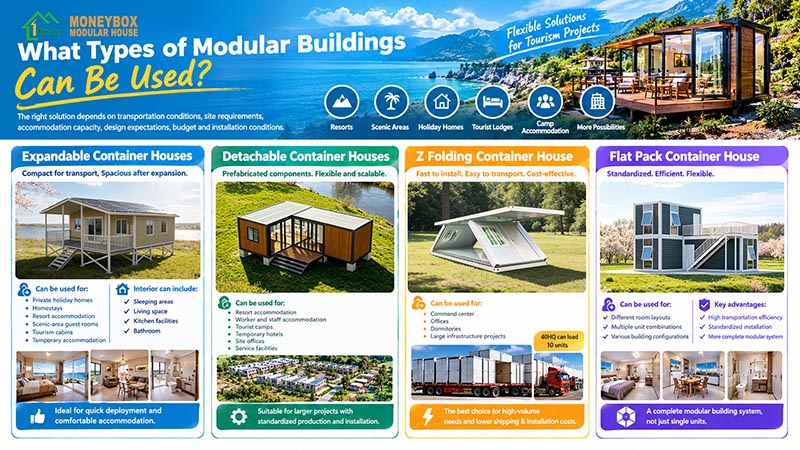
What Types of Modular Buildings Can Be Used?
The right solution depends on transportation conditions, site requirements, accommodation capacity, design expectations, budget and installation conditions.
Expandable Container Houses
Expandable container houses are particularly interesting for tourism accommodation because they can provide a relatively compact transportation configuration while creating a larger usable interior space after expansion.
They can be used for:
With suitable interior configurations, an expandable unit can include sleeping areas, living space, kitchen facilities and a bathroom.
For projects that prioritize quick deployment and comfortable accommodation, this type of modular unit can be an attractive option.
Detachable Container Houses
Detachable container houses are another practical choice for larger tourism developments.
They can be assembled on-site from prefabricated components and are suitable for projects requiring multiple standardized accommodation units.
Potential applications include:
Their modular structure can also make them suitable for larger projects where standardized production and repeated installation are important.
Z Folding Container House
Z Folding Container Houses are a currently popular model—a highly efficient, quick-to-deploy unit. It is not only simple to install (taking just two workers 10 minutes to complete) but also exceptionally easy and fast to transport, with a 40HQ can load 10 units.
For clients with high-volume requirements who also wish to save on shipping and installation costs, this is arguably your best choice.
Flat Pack Container House
Flat pack and modular systems can be considered when transportation efficiency and standardized installation are key priorities.
Multiple units can be combined to create different room layouts and building configurations.=
This creates a more complete modular building system rather than treating accommodation as individual standalone units.
Design Matters: Modular Does Not Mean Basic
One common misconception is that modular accommodation must look like temporary housing.
Modern modular buildings can be designed with a strong focus on appearance, comfort and the guest experience.
For tourism projects, developers can consider:
The objective is not simply to provide a building.
A well-designed modular cabin overlooking a lake or surrounded by mountains can offer a very different experience from a conventional hotel room.
How to Plan a Modular Tourism Accommodation Project
Before selecting a modular building, project owners should define several important requirements.
1. Determine the Number of Guests
Start with the expected number of guests and the required number of rooms or accommodation units.
2. Analyze the Project Location
Consider:
Remote locations require particularly careful logistics planning.
3. Define the Accommodation Standard
A basic tourist cabin and a premium resort villa have very different requirements.
Determine whether the project requires:
4. Consider Future Expansion
Do not only consider today's demand.
If the tourism project is expected to grow, the initial modular system should ideally allow additional units or facilities to be introduced later.
5. Plan Transportation and Installation
The building design should be evaluated together with its transportation method.
The number of units per container, loading configuration, shipping route, unloading conditions and on-site assembly requirements can all affect the total project cost.
Modular Tourism Accommodation vs. Traditional Construction
The right choice depends on the project.
| Factor | Modular Accommodation | Traditional Construction |
| Factory production | High | Limited |
| On-site construction | Reduced | Usually extensive |
| Project expansion | Flexible | Often more complex |
| Standardization | High | Project dependent |
| Remote-site suitability | Potentially strong | Can be challenging |
| Design customization | Available | High |
| Transportation planning | Important | Important |
| Construction method | Modular/prefabricated | Site-built |
When speed, repeatable units, transportation, flexibility and phased expansion are important, modular construction can offer significant advantages.
A Complete Modular Solution for Tourism Projects
A successful tourism accommodation project involves more than supplying individual houses.
Developers may also require:
A supplier with manufacturing and engineering capabilities can help coordinate different building types and provide a more integrated solution.
Why Choose Moneybox House for Modular Tourism Accommodation?
Guangzhou Moneybox Steel Structure Engineering Co., Ltd., specializes in container houses, prefabricated buildings, modular building solutions and steel structures.
For tourism and accommodation projects, Moneybox can provide different types of modular building solutions according to project requirements.
The product range includes:
The company can support customers through customization, manufacturing, project supply, delivery coordination and installation support.
This makes modular construction more than a simple product purchase—it can become a complete project solution.
Conclusion
Tourism accommodation needs to respond to changing markets, seasonal demand and different project locations.
Whether the goal is to build a small mountain homestay, expand a beach resort, develop accommodation in a scenic area or create a large-scale holiday village, modular buildings provide a flexible approach to tourism development.
With appropriate planning, modular accommodation can combine efficient manufacturing, flexible layouts, scalable development and modern comfort.
FAQ: Modular Tourism Accommodation
What is modular tourism accommodation?
Modular tourism accommodation refers to prefabricated or modular buildings designed for hotels, resorts, scenic areas, holiday villages, homestays and other tourism projects.
Are modular buildings suitable for resorts?
Yes. Modular buildings can be used for resort guest rooms, cabins, villas, staff accommodation and supporting facilities, depending on the project design and local regulations.
Can modular accommodation be used in scenic areas?
Yes. Modular accommodation can be suitable for mountain, forest, lakeside and other scenic tourism projects, provided transportation, foundations, planning and environmental requirements are properly addressed.
Can modular tourism accommodation be customized?
Yes. Depending on the building system, accommodation units can be customized in terms of layout, size, interior configuration, exterior finishes, doors, windows, electrical systems and other requirements.
Can a modular resort be expanded later?
One of the major advantages of modular construction is scalability. Additional accommodation units and supporting facilities can potentially be added as the tourism project develops.
How do I choose the right modular accommodation for my project?
Consider the project location, number of guests, accommodation standard, transportation route, installation conditions, local regulations, budget and future expansion plans before selecting a building system.


 serviço on-line
 +86-020-34800775+8618818900230
 export@moneyboxhouse.com
 +8615920397177
 1198017314
 português
 English
 español
 français
 Deutsch
 русский
 italiano
 Nederlands
 Ελληνικά
 हिन्दी